
The Byzantine Emperor: How to Survive the Throne
Power, politics, and the perils of imperial rule
Saturday, 7 November 2026 · 17:00 EET
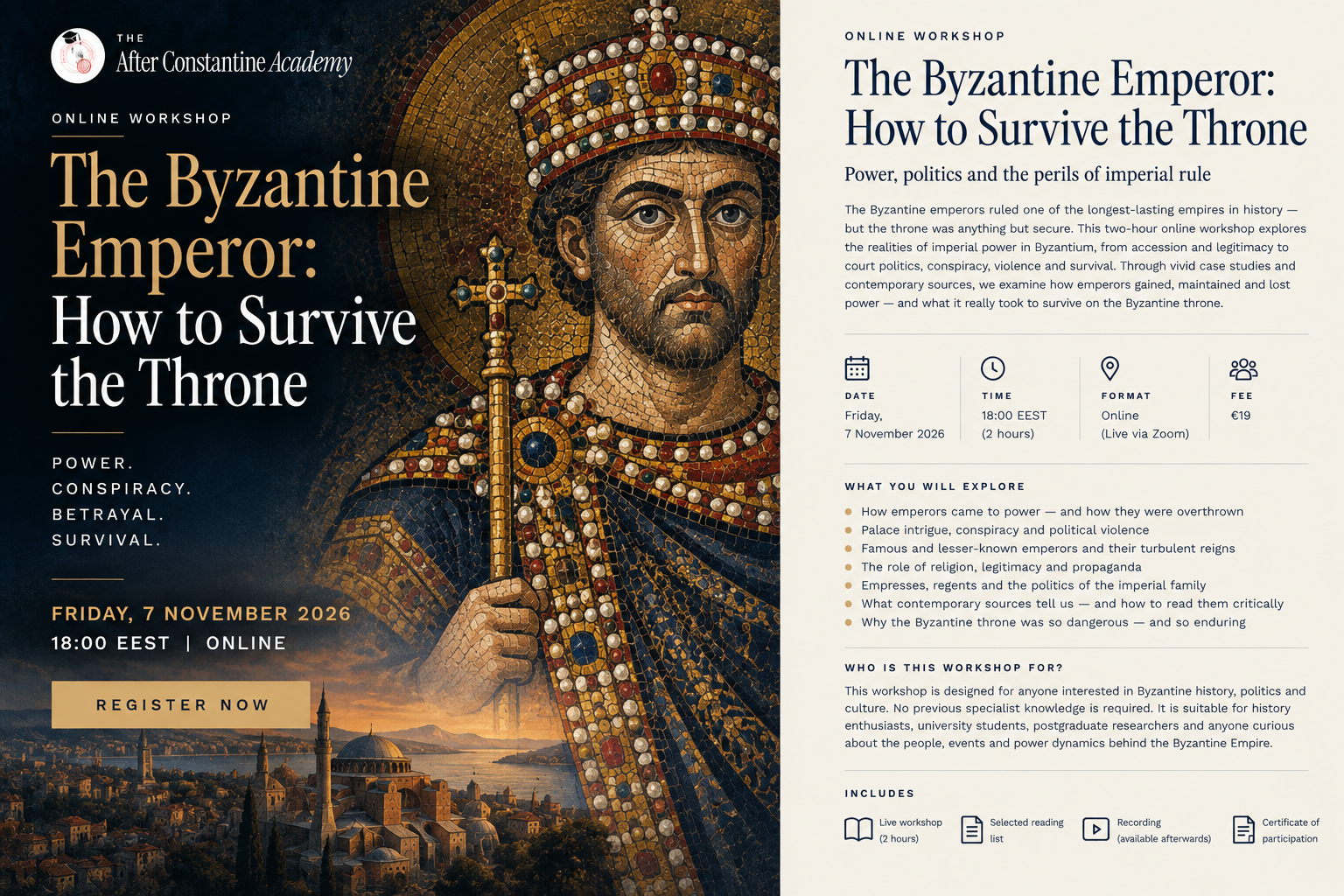
For more than a thousand years, the Byzantine throne stood at the centre of a complex political world shaped by dynastic ambition, military power, religious authority, court ceremony, popular opinion, and personal rivalry. Emperors might present themselves as God-appointed rulers, yet their position was rarely beyond challenge. Rebellion, conspiracy, deposition, exile, mutilation, and assassination were persistent possibilities of imperial life. This two-hour online workshop examines how Byzantine emperors gained, maintained, and lost power. Through selected emperors and dramatic episodes from Byzantine history, we will investigate the strategies rulers used to establish legitimacy, secure allies, control rivals, manage the imperial family, and present themselves to their subjects. But imperial survival depended on more than force. Why did some usurpers successfully transform themselves into legitimate emperors? Why could military victory strengthen one ruler but fail to save another? What roles did the army, Church, aristocracy, imperial women, and the population of Constantinople play? And what happened when an emperor lost control of the political narrative surrounding his reign? Working with chronicles and other Byzantine sources, participants will also consider a fundamental historical problem: how can we reconstruct Byzantine court politics when many of our sources were written by authors who admired, hated, or sought to discredit the emperors they described? The result is a journey into the mechanics of Byzantine power — and into the precarious lives of the men and women who lived closest to the imperial throne. This workshop is designed for anyone interested in Byzantine history, politics, emperors, and court culture. No previous specialist knowledge is required. It is suitable for history enthusiasts, university students, postgraduate researchers, and anyone interested in understanding how power actually functioned within the Byzantine Empire. Participants receive access to the live workshop, a selected reading list, the recording after the event, and a certificate of participation.
- 01How Byzantine emperors came to power — and how they were overthrown
- 02Palace intrigue, conspiracy, rebellion, and political violence
- 03How usurpers attempted to turn seizure of power into legitimate rule
- 04Dynasties, marriage, succession, and the imperial family
- 05Empresses, regents, generals, courtiers, and other figures behind the throne
- 06Religion, ceremony, imagery, and propaganda as instruments of legitimacy
- 07Exile, deposition, mutilation, and other methods of removing political rivals
- 08How Byzantine chroniclers constructed the reputations of emperors
- 09Why the throne was so dangerous — yet imperial rule proved remarkably durable
Zoe Tsiami works at the intersection of religious history and social history in the late antique and Byzantine Mediterranean. Her scholarship attends to the everyday textures of Christian life — persecution, memory-making, liturgy, and civic identity — from the age of the martyrs through the middle Byzantine centuries.